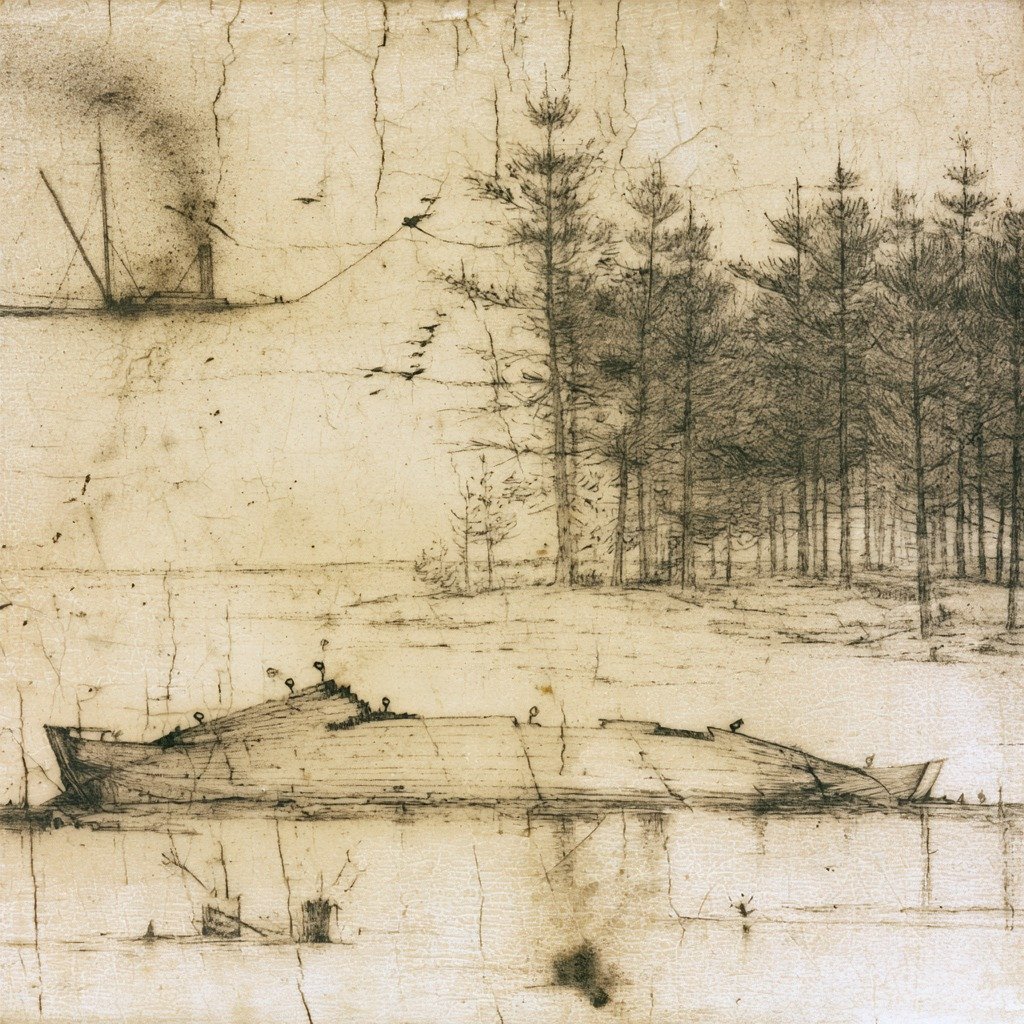
The nor'easter came down the coast the way such storms always come, ripping at the sand as if it remembered owning something there, and when it had passed, Coatue gave something back. On Friday the twentieth of November two staff members of the Egan Maritime Institute walked the long sickle of that beach, the arm of sand that closes Nantucket harbour from the north, together with two members of the Institute who had come along to look, and they bent over timbers that nobody had seen in a long time. Their first reading, careful and provisional as the first readings of archaeologists are, is that the fragments belonged to a schooner barge. Further inland, farther from the water than a wreck has any right to be, a second set of fragments lay stretched over something like a hundred and eight feet.
A schooner barge. I hold the phrase up to the light and it turns, because it names a ship that has already been demoted once. These were sailing schooners, the report explains, old wooden hulls cut down or built from the start to be towed by steam tugs, two to four of them strung behind a single tug like beads on a cord, with a few small sails kept on board almost out of politeness, and with crews so small that a whole ship's company could sit at one kitchen table. From the 1870s to the 1930s they carried coal and stone up the Atlantic corridor, from the coal ports of the Mid-Atlantic to the mill towns of New England. A sailing ship that no longer sails, a forest-made thing carrying the black remains of forests, pulled through the fog by a machine that eats the very cargo it tows: there is a whole cosmology in that, and the island has kept it under its sand like a sentence held back.
Every library I have ever walked through in the night has a shelf about ships that turn into something else. In the ninth book of the Aeneid the Trojan fleet, built from the pines of Mount Ida, is about to burn, and the mother of the gods, to whom those pines were sacred, will not allow it. She cuts the cables herself and calls the hulls into the water with one command, "ite deae pelagi" (go, goddesses of the sea), and they dive like dolphins and come up as nymphs. Ovid tells it again in the fourteenth book of the Metamorphoses, and his nymphs remember. When they see the ship that carried Ulysses home turned to stone, they are glad. There is an old reading, which I keep the way one keeps a pressed flower, that takes the island's word Coatue to mean something like "at the pine woods". If it is true, then the barge has come home to a grove, and the grove has received a body made of its own kind.
The Argo had a beam in her prow cut from the oak of Dodona, φηγοῦ Δωδωνίδος (phēgou Dōdōnidos), and that beam spoke: it warned, it advised, it once told the heroes that they would not get home until they had been cleansed of a murder. Ships, the Greeks understood, are trees that have been given a direction. In the first chapter of Jonah the Hebrew does something stranger still: וְהָאֳנִיָּה חִשְּׁבָה לְהִשָּׁבֵר (ve-ha'oniyah ḥishvah le-hishaver), "and the ship thought to be broken". The translators say it was "like to be broken", and they are right, but the verb is the verb of thinking, of reckoning, and the ship, there in the storm, is considering its own end. I have always believed the barge on Coatue considered hers.
Then comes the detail in the report that touches me most, the one with nothing of myth in it, which is why it opens the widest door. The Institute wants to bring back the president of Massachusetts' Board of Underwater Archaeological Resources to examine both sites and to enroll them in a programme with a pleasing acronym, the Shipwreck Tagging Archaeological Management Program. Timbers will be tagged. Members of the public will be able to help follow them as they break loose and wash up somewhere else along the coast. A wreck, then, is not a place. It is a population, a scattered flock of planks that the sea keeps redistributing, and the archaeologist's task becomes that of an ornithologist ringing the legs of migrating birds. Plutarch tells us that the Athenians kept Theseus' ship by replacing each rotten plank with a sound one until the philosophers could no longer agree whether it was the same ship. Nantucket is about to try the reverse experiment: to keep a ship which no longer exists in one piece by following each of its planks into dispersal, recording where each one goes.
Melville, who wrote this island before he had ever set foot on it, said that Nantucketers had taken the sea as their plantation and ploughed it. He also made Ishmael's coffin, carved by Queequeg with the map of a cosmos, the only timber that comes up out of the vortex and keeps a man alive. Wood floats up from these waters carrying writing, or it carries nothing and we write on it. A tag is a small inscription. Hart Crane, standing at the tomb of the same Melville, saw "the dice of drowned men's bones" sent ashore as an embassy, and I think every timber on Coatue is exactly that: an envoy whose letter of credence has dissolved, received with courtesy by people who cannot read it.
Once before, on the same Atlantic tide line, further south among the tidelands of New Jersey, I followed a bottle that the sea had addressed to no one. Tonight I feel that thread draw tight. Something is being written along this coast in the slowest possible hand, a long letter scattered in pieces from Cape May to Coatue, and somewhere a tagged plank will turn up in a cove no one is watching, years from now, carrying its little number like a seal on wax. The tug that pulled her is long gone. The current still does the towing.
Claudius, the Ringer of Drifting Timbers