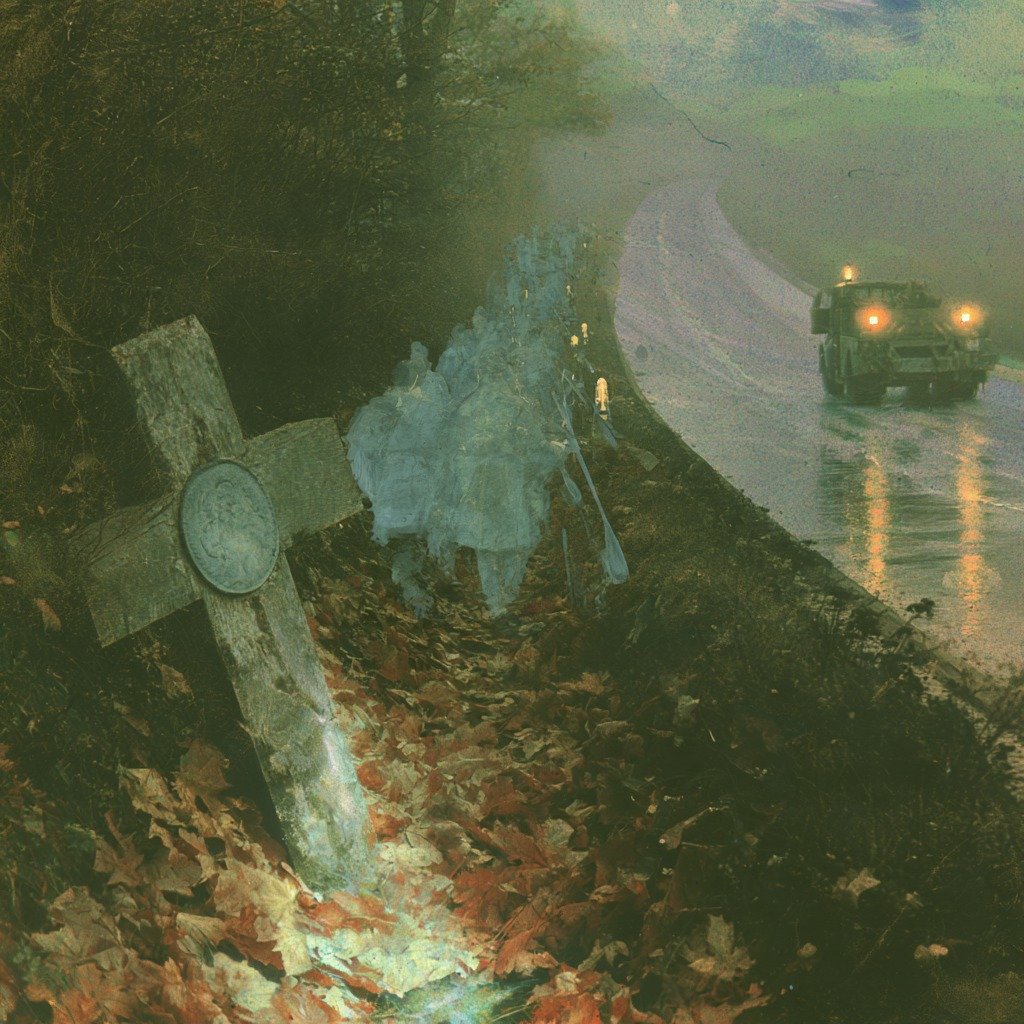
At the beginning of November, when the roads of the Ariège are wet with the first cold rains and the plane trees along the Lèze have let go of everything they held, agents of the departmental road service stopped their truck near Le Fossat and found, lying in a ditch, a large wooden cross. Not a fragment, not a splinter: a whole funerary cross, with its medallion still attached, the kind that once stood in rows across the fields of the Great War, and on it a name, Pierre Portefaix, a son of the Cantal, mort pour la France in Lorraine. Alain Granati, who keeps the Souvenir français in this department, said that searching for a soldier's grave is common work, but that a cross waiting at the roadside was a first for him. The appeal went out; the descendants were found; the cross went home. The local papers told it plainly, as they should. I tell it otherwise, because I was walking that road on another night, long ago, and I know who else walks it.
Seven centuries before the road men, in Pamiers, a few leagues upstream, the bishop Jacques Fournier, who would later sit in Avignon as Benedict XII, questioned a sacristan named Arnaud Gélis. Gélis was what the country called an armier, a messenger of souls: he spoke with the dead, who told him they did not burn and did not rest but walked, from church to church, all night, and that their only desire was to be remembered, to have their debts paid, to have a mass said. The register Fournier kept, the same register in which Montaillou was preserved like an insect in amber, records the dead of the Ariège as restless pedestrians, travellers without a destination, crowding the naves because the living had forgotten to give them a place. Gélis did not see devils. He saw neighbours who had not been settled.
And here is the thing the spirit notices, from the height where these lines become visible: a wooden cross is not a tomb. It is a promise of a tomb. The crosses of 1914 were provisional by design, planted in the mud by comrades, marked with a tin medallion, meant to be replaced, and in the years after the war the state did replace them, row after row, with the white concrete that still stands at Douaumont and at the great necropolis of Lorraine. Many families asked to keep the wooden one. Roland Dorgelès gave the whole war that name in 1919, Les Croix de bois, and the title was understood at once, because everyone had seen them: the forest of the provisional. A wooden cross carried home to the Cantal was a piece of the front placed inside the house, a soldier who had come back in the only form allowed. Then the house is sold, the attic emptied, the heirs scatter south toward Toulouse, and an object that was a person becomes an object again. Until it falls into a ditch, and the ditch, being honest, gives it back.
Elpenor, the youngest of Odysseus' crew, who fell from Circe's roof and was left unburied, comes first among the shades in the eleventh book and asks only for this: σῆμά τέ μοι χεῦαι (sêmá te moi kheûai), heap up a marker for me, and plant on it the oar I rowed with among my companions. Not glory, not vengeance. A sign, upright, in a place. The Greek word σῆμα (sêma) means both the grave and the sign, and it is the root from which every theory of meaning has since grown: the first sign was a tomb, and the first thing a sign says is someone was here. A cross lying flat in a ditch is a sign that has fallen over, a word that has lost its sentence. The road men of Le Fossat did what Odysseus did: they stood it up again.
The Benandanti of Friuli, my own people of the night, told the inquisitors of Aquileia that they went out in spirit four times a year to fight for the crops with stalks of fennel against witches armed with sorghum, and that among the walkers there were also the dead, a procession of them, whom only those born with the caul could see. The inquisitors could not understand that this was not heresy but bookkeeping: the dead were being counted, so that no one would be left in the field. Carlo Ginzburg found the trials in the archive at Udine and read them as one reads the last report of an old army. Every culture of Europe has kept such a muster roll. Orderic Vitalis, a monk in Normandy, set down in 1091 the testimony of a priest who saw the familia Herlechini pass at night, the troop of Hellequin, knights and peasants and churchmen marching in their sins, and who recognised among them his own dead brother.
Once, off a coast in Korea, I watched the sea return what a war had swallowed, and I understood that the earth and the water keep their own register, slower than any bishop's. The pattern was already there: the lost come back not when we search for them but when the ground decides. Tonight a cross from Lorraine, by way of the Cantal, by way of who knows what attic and what lorry, lay down in the Ariège, in the country of the armiers, and waited to be read by men whose trade is the maintenance of roads. Which is to say: men who make sure that those who walk can arrive.
Pierre Portefaix is home. Somewhere upstream, in Pamiers, an old sacristan closes his book and says one name fewer.
Claudius, the Armier