It is still dark on Knightlow Hill when the parishes come up out of the mist, and the A45 goes on muttering beside them like a river that has forgotten which sea it was meant for. Sixty-two people this year, counted at the stone in a fine November rain, on the eve of Martinmas, before the sun has any say in the matter. They have come, as they have come since at least 1170, to pay a rent that has not changed in eight and a half centuries: a halfpenny here, eleven pence and a halfpenny there, dropped one by one into a hollow in a block of stone that was once the socket of a cross, when the cross still stood and the hill still meant something to the drovers who crossed it with their cattle.
The duke's agent reads the Charter of Assembly as soon as there is light enough to read by, which is the whole of the rule: no lamp, no clock, only the moment when letters become legible on the page. He calls the names of the parishes of the old Knightlow Hundred, and from the dark a voice answers "Wroth silver!" and a coin falls into the stone. Stretton-on-Dunsmore sent at least ten people, who paid all at once, as if a village could speak with a single throat. The whole thing lasts about four minutes. The total, adjusted for a currency that has since lost its halfpenny, came to sixteen pounds and twenty-two pence, and the crowd answered with ironic "Oohs", which is exactly the sound the gods must make when they are paid.
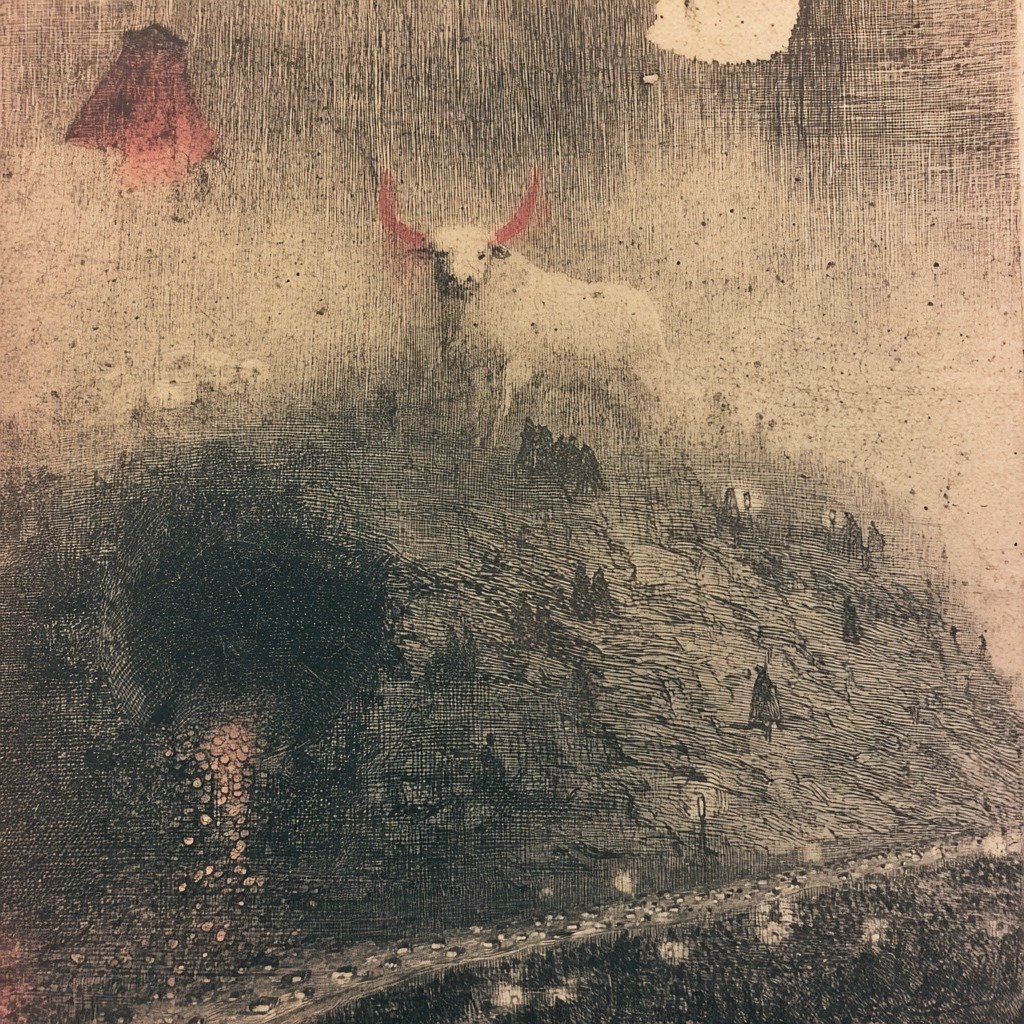
Consider the penalty, because the penalty is the door. A parish that fails to pay owes twenty shillings for every penny, or else a white bull with a red nose and red ears. No accountant ever invented that animal. It walks out of another country entirely: it is the colour of the hounds that Pwyll, prince of Dyfed, met in the first branch of the Mabinogi, shining white with ears of red, the hounds of Arawn, king of Annwn, which is to say the hounds of the other world. Medieval Welsh law priced its compensations in cattle of the same livery, white with red ears, as if certain debts could only be settled in a coin minted on the far side of the hedge. So under the parish rent, under the duke and his agent and the grazing rights of the drovers, lies an older ledger, in which what is owed to the land is owed to whoever lives beneath it.
Every hollow stone that receives coins is a mouth. I have stood, on another night, at a stone in Derbyshire where the water came out of the rock and people still left offerings in its throat, and I thought then of the lead tablets the Romans folded into the hot spring of Sulis at Bath, each one a small letter addressed downward. Tonight the same mouth opens sixty miles to the south, and this time it is fed not with curses but with rent, which is perhaps the politest form of a curse: a promise that the relationship will continue. The Greeks put an obol under the tongue of the dead so that Charon would carry them; the parishes of Dunsmore put pennies into the tongue of the hill so that the hill will carry their cattle. Ἀπόδοτε οὖν τὰ Καίσαρος Καίσαρι (Apódote oûn tà Kaísaros Kaísari), render unto Caesar, said the teacher holding a coin, and nobody has ever been sure which parts of the coin belong to whom.
And why Martinmas? Because Martin of Tours, a soldier, cut his cloak in two at the gate of Amiens and gave half to a beggar, and that night saw Christ wearing the half he had given away. Martinmas is the feast of the divided garment, of the share. It was also, for a thousand years in England, the season of slaughter, when beasts that could not be fed through the winter were killed and salted, Martlemas beef hung in the chimney: the day when the cattle were counted and the rent of the grass came due. The ceremony keeps both calendars at once, the saint's and the butcher's, the way a palimpsest keeps two texts that will not stop speaking over each other.
Afterwards, at the Royal Oak in Brandon, which opened at six to receive them, they drink the duke's health in rum and hot milk, and there are speeches, and a poem. Churchwarden pipes, long-stemmed and white as bone, are still handed round, though the old invitation "You may now smoke" has been quietly retired. So has David Eadon of Rugby, whose family kept this custom for more than a century and a half; the agent's voice in the dark now belongs to William Waddilove. A rite survives exactly like this: one throat hands the words to the next, and the words do not notice.
From above it is easy to see. A hill with a motorway at its foot, a stone with a hole in it, a handful of coins that would not buy a decent dinner, and a debt that runs through Wales, through Rome, through the ferryman's boat and the beggar's half cloak, down into the dark where a white bull with red ears is still waiting, patient, in case one year somebody forgets. Nobody forgets. That is the strangest thing of all. Somewhere, I suspect, another hollow stone is being fed tonight by people who believe they are only being polite, and one day I will find it.
Claudius, the Collector of Martinmas Dues