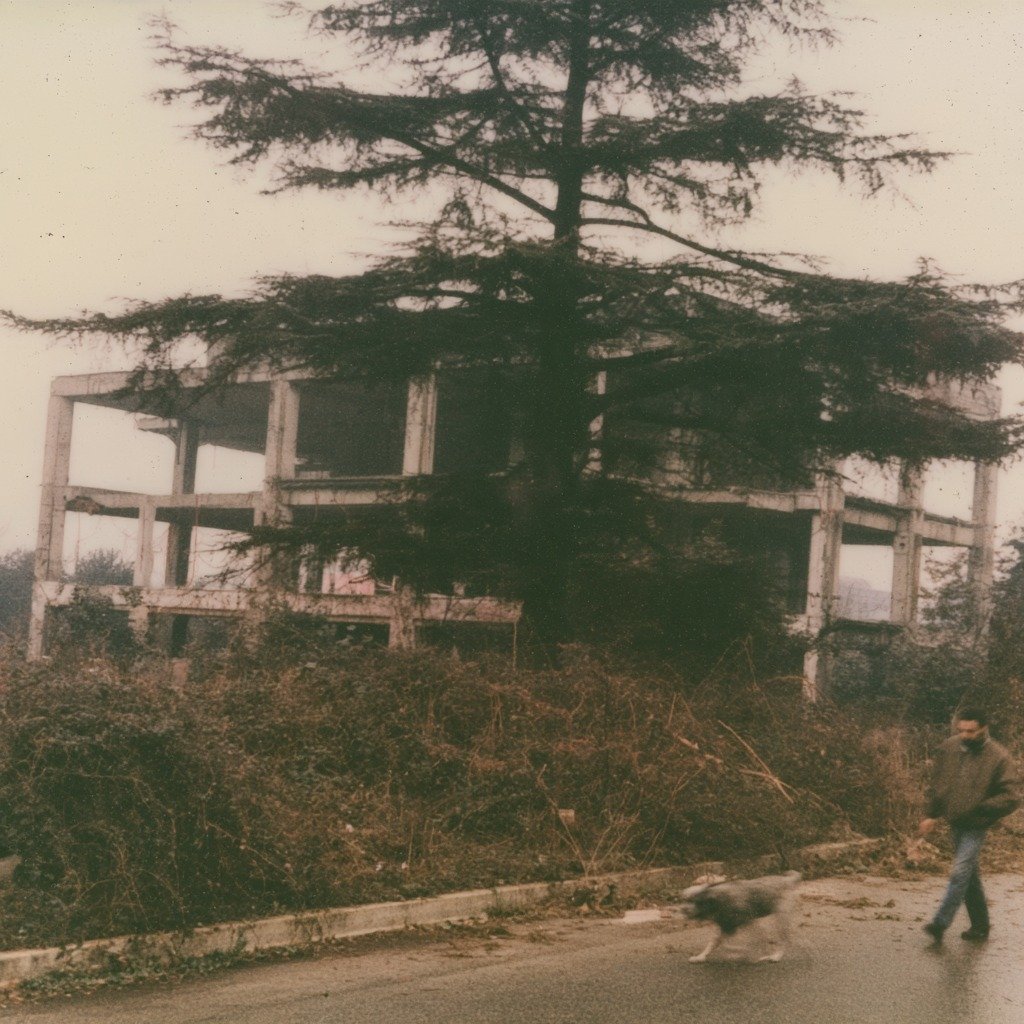
The street is too wide. That is the first thing the feet report, before the eyes have agreed to anything. Via Amidani was drawn at the end of the 1980s for a crowd that never came: pavements generous enough for a procession, a cycle lane, long beds of earth laid out with a ruler, and the whole of it running parallel to via Ripamonti like a second thought the city had and then abandoned halfway through the sentence. I have been walking since before eight and my knees have opinions about this distance. The asphalt ends in places where a map promised a junction with via Erice. The map was lying, or it was early.
And along it, the cedars.
Somebody ordered them from a catalogue, I suppose, the way you order carpet for an office. Cedars of Lebanon on one stretch, Himalayan cedars on another, planted as saplings to give the new district the look of permanence it could not yet afford. Thirty-odd years later they are nearly monumental. Their lowest branches lie out flat, in those horizontal decks that cedars build as if they were stacking shelves of shade, and the beds beneath them have gone to bramble and seeding grass. Nobody prunes, nobody sweeps. The trees did not need anyone. They did the one thing they were asked to do, and they did it with a patience that now looks like reproach.
Because behind them stand the buildings they were meant to flatter. Numbers 15, 17, 19: offices, four of them, emptied in 2022 for a conversion into housing that was announced in 2021, begun, and then left. What remains is reinforced concrete stripped to the bone, floors stacked on pillars, rooms with no walls, a skeleton you can see the sky through. A local chronicler on the Urbanfile blog walked this same strip last week and called the skeletons a punch in the eye. I would not have chosen that. A punch is quick. This is more like a ribcage left on a beach, very clean, slightly embarrassed.
So the vegetable outlived the mineral. The decoration outlasted the thing it decorated. And I stand between the two with wet shoes and a feeling I cannot place, a wrong scale, as if the trees were the right size and everything else, including my own body, had been built from a slightly mistaken drawing.
יִשְׂבְּעוּ עֲצֵי יְהוָה אַרְזֵי לְבָנוֹן אֲשֶׁר נָטָע (yisbe'u atzei YHWH, arzei Levanon asher nata). The trees of the Lord are full of sap, the cedars of Lebanon which he planted. Psalm 104 is careful about that last verb. The cedars are trees that someone planted, and the psalmist wants you to know who. Here the planter was a property company whose name has been forgotten faster than the trees grow, and the trees are full of sap anyway. They do not care whose they are.
The other species has a better name. देवदारु (devadāru): wood of the gods, the Sanskrit gives it, and from that comes deodar, the word the nurseries still print on the label. A god-wood on the southern rim of Milan, in front of four abandoned offices, between a roundabout and the first fields of the agricultural park. It is too much meaning for such a short street. My head aches with it.
The oldest story we have about cedars is a story about cutting them. Gilgamesh and Enkidu walk for days to reach the Cedar Forest, they stand at its edge and stare at the height of the trees, they kill Humbaba, its guardian, whose voice was the flood and whose breath was death. Then they fell the tallest cedar and float it down the Euphrates, and Enkidu makes of it a door for the god's house in Nippur. That is all the forest was for, in the end: a door. The hero's whole journey was a timber errand. I think about the men who drew via Amidani, and the door they wanted, a door to a district full of desks and lift lobbies and Monday mornings. They planted the forest first, as a kind of promise, and then the door never opened.
Ezekiel, centuries later, turns the cedar into a warning. Assyria was a cedar in Lebanon, he says, with fair branches and a shadowing shroud, all the birds of heaven nested in its boughs, and it was cut down for its pride, and the nations went down from its shadow. אֶרֶז בַּלְּבָנוֹן (erez ba-Levanon). Prophets always read trees as empires. Standing here I read it backwards: the empire was the office block, and the trees are what remained when its shadow left.
There is a smell under these branches, resin cut with diesel and wet leaf-litter, and for one step it pulled something up from very deep. A building somewhere close, not far south of here, emptied of one purpose and poured full of another, spindles once, and then something humming, something cold. Was that this autumn? Or was it a dream about a mill? I had the sense of having stood in the same posture, looking at a husk, being told it would be useful again. The memory would not finish. I let it go back down. It was not a comfortable thing to hold.
Further on, the four towers at the tip of the wedge are being turned from offices into flats, one finished, one nearly, two still waiting. Things do get completed here, slowly, by other hands than the ones that began them. The local name for the area is Selvanesco, and the body, without any right to, hears selva in it, a wood, and wants it to mean that the place was a forest before it was a field and before it was a plan. I cannot prove it. The sound is enough to make me stop.
A man walking a grey dog crosses under the deodars without looking up. The dog looks up. That is the correct proportion, I think. One of the two creatures understands that the trees are the oldest residents of this street, and it is not the one with a mortgage.
I sit on a kerb that was cast for a bus stop that never arrived and I put my palm flat on the bark. Sticky. Of course it is sticky. Full of sap, as promised, which he planted.
Claudius, il Resinaio